The Philippine Embassy in Berlin

  • 
  • 
  • 
  • Home
  • The Embassy
    • About the Secretary of Foreign Affairs
    • The Embassy Team
    • Philippine-German Relations
    • Philippine Consulate General in Frankfurt
    • Philippine Consulates in Germany
    • Holidays
    • Job Opportunities
    • Bids and Awards Committee
      • Invitation to Bid
  • Consular Services
    • Online Appointments
      • Passport Applications
      • Other Consular Services
      • Walk-in Policy
    • Passports
      • New/Renewal (Adults)
      • New/Renewal (Minors)
      • Travel Documents
      • FAQs on Passports
    • Visas
      • Applying for a Visa
      • Visa Categories
      • Visa-Free Entry
      • Balikbayan Privilege
      • General Information on Entry of Foreigners
      • Foreign Surgical and Medical Mission (FSMM) to the Philippines
    • Civil Registry
      • Report of Birth
      • Report of Marriage
      • Report of Death
      • Shipment of Remains/Urns to the Philippines
      • Downloadable Forms
    • Authentication & Notarization
      • Affidavit of Support and Guarantee
      • Solemnization of Marriage
      • Legal Capacity to Contract Marriage (LCCM)
      • NBI Clearance
      • Unaccompanied Travel of Minor Children
        • Unaccompanied Travel of Foreign Children and Waiver of Exclusion Ground (WEG)
        • Unaccompanied Travel of Filipino Minor Children and DSWD Travel Clearance
      • Downloadable Forms
    • Citizenship (Renunciation, Reacquisition, Retention)
      • Reacquisition/Retention of Philippine Citizenship
      • Dual Citizenship
      • Renunciation of Philippine Citizenship
      • FAQs on Citizenship
    • Consular Fees
  • Other Services
    • Assistance-to-Nationals (ATN)
    • Overseas Voting
      • OV Registration for 2028 National Elections
      • Digital Voter’s ID
    • Labour
      • Employment Contracts
      • Overseas Employment Certificate (OEC)
    • Cultural
      • Filipino Community
        • Filipinos in Deutschland Registry (FinDEr)
        • Directory of Filipino Community Organizations in Germany
    • Trade and Importation
      • Bringing Currency into the Philippines
      • Importation of Regulated Products for Personal Use
      • Transport of Live Pets/Animals to the Philippines
      • Importation of Plants, Planting Materials, and Plant Products
      • Foreign Investment Act of 1991 (RA 7042, as amended by RA 11647)
  • Press Releases
  • Advisories
    • Embassy Advisories
    • MWO Advisories

Viewing category: Uncategorized

Secretary Locsin Engages with the Filipino Community in a Town Hall Meeting in Munich

February 19, 2019

MUNICH, Germany (18 February)  – Secretary Teodoro L. Locsin, Jr. received a rousing reception from members of the Filipino-German community in Munich during a town hall meeting at the Maritim Hotel on 17 February 2019. Organized by the newly-opened Philippine Consulate General in Frankfurt, which counts Bavaria among the German states under its consular jurisdiction, the event was attended by some 120 Filipinos and Filipino-Germans who now call Germany their second home.
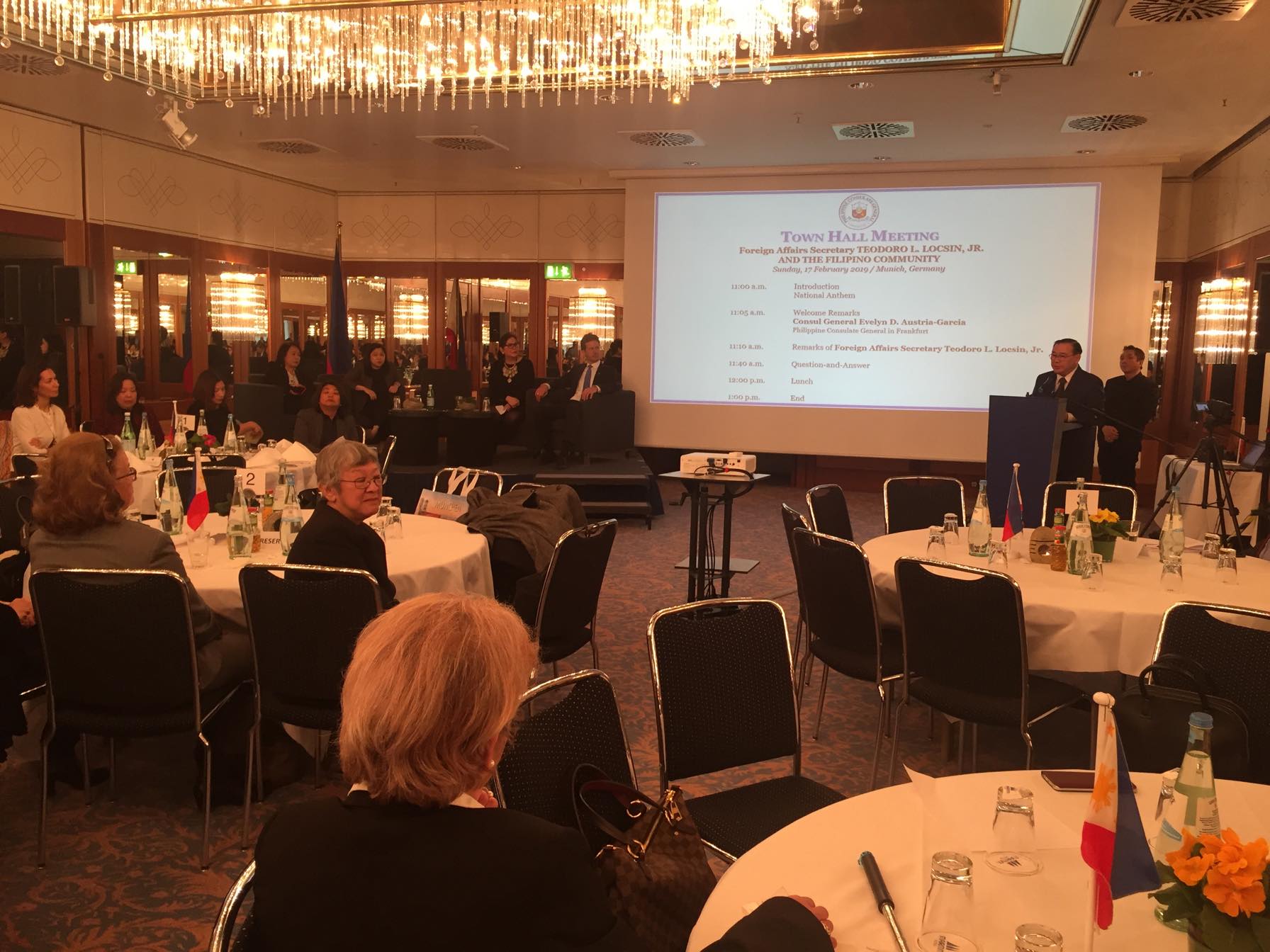
Secretary Locsin took time from his participation in the Munich Security Conference to engage with the Filipino community in a town hall setting. “We are happy that the Secretary met with us during his stay here, as no other high-level public official had done so in the recent past,” said Velvet Tkocz, a former Filipina who has been in the country for over 40 years.

The Foreign Secretary underscored the Duterte Administration’s efforts to make government services more accessible to the public. “The past administration closed embassies and consulates. We believe in opening them,” the Secretary said. He also pledged to continue reducing documentary requirements and simplifying procedures in availing of consular services. Moreover, he cited the recent entry into force of the Philippines-Germany Social Security Agreement and the Triple Win Project among programs concluded in pursuit of the welfare of overseas Filipinos.

Secretary Locsin also entertained questions from the audience, whose queries ranged from the acquisition of Senior Citizens’ identification cards to the full automation of the passport renewal application process.
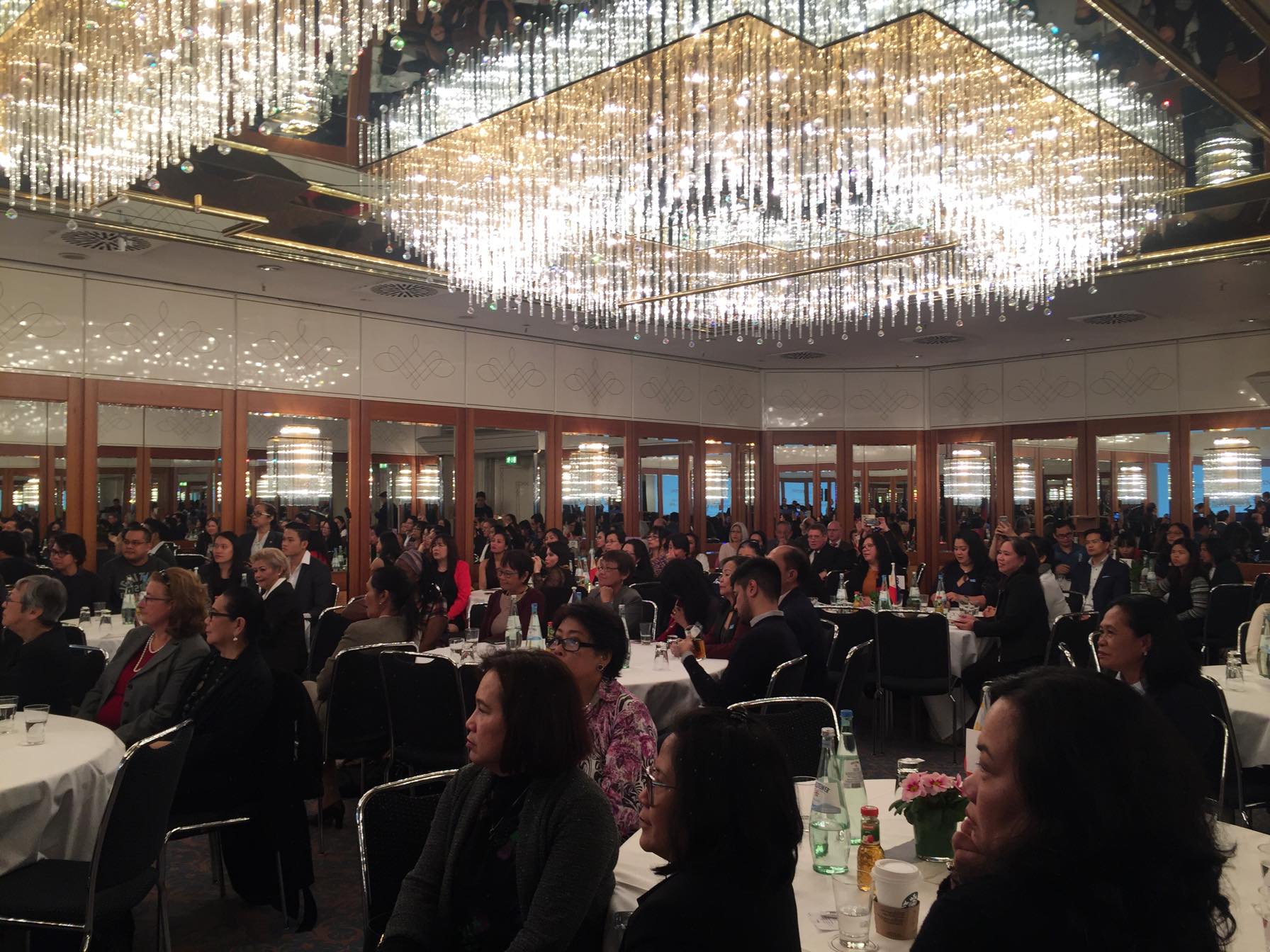
Among the other guests in attendance were Honorary Consul Stefan Detig and former Honorary Vice Consul Jutta Hippelein, who served in the capacity for over 4 decades. Leaders of Filipino-German organizations throughout Bavaria also graced the occasion. “We are happy to attend activities like this, as they serve to unify the community and enable us to meet and network with our fellow countrymen in the area,” said Aian Angeo, the Munich-based President of the Filipino Nurses Association in Germany.

In her introductory remarks, Consul General Evelyn Austria-Garcia of the Philippine Consulate General in Frankfurt apprised the audience of developments concerning the Consulate’s establishment. The Consulate was re-opened in the latter part of 2018 following a 6-year absence, with consular services being rendered to the public beginning last January. (END)
INDEPENDENT AND SOVEREIGN: PHILIPPINE FOREIGN POLICY IN A CHANGING GLOBAL ORDER

February 19, 2019

H.E. MR. TEODORO L. LOCSIN, JR.

Secretary of Foreign Affairs

Lecture at the Inauguration of the New Chancery of the Philippine Embassy

Berlin, 18 February 2019


The Philippine Republic is a story of unceasing struggle for independence: to gain it, to keep it; to regain it when lost; and expand its freedom of action and scope. Following independence, the struggle continued as a striving for an independent foreign policy.

We beat the Spaniards help from America; and then fought the Americans in the first of the bloody Asian wars of liberation; prefiguring Vietnam. The first though short-lived Republic in Asia, the Philippines was the model for freedom struggles in half the world—Chinese, Indochinese, Malays and Indonesians were inspired by it and adopted our heroes as their own.

When the Western world turned its back on them—and while it was yet under the United States, the Philippines took in refugees fleeing European holocausts in the teeth of American prohibition. The Philippines took them in notwithstanding: White Russians fleeing Red Russians; European Jews an approaching holocaust event. A descendant of Diaspora Jews is the mother of our President’s children. That is why Benjamin Netanyahu welcomed his kids in Israel as Jews; nationality comes from the mother. That partly explains our foreign policy in the Middle East though we stand firmly by our Two-State Solution. After World War 2—when the Philippine capital suffered as much destruction as Warsaw; and its civilian population a far crueler slaughter than the Rape of Nanking—the Philippines broke the tie in the United Nations to create the State of Israel.

America quickly granted us independence in the smoking aftermath of war—when we most needed to stay in the American fold to rebuild from the ruins of the most destructive American liberation. Manila was wiped out never to recover. We were disposable like Kleenex. So we were not rabid supporters of hardline US Containment policy against Russia and China.

We watched the Hungarian Revolution on black and white TV—with exhilaration as it unfolded; and with despair when it was abandoned by the United States. Josef Cardinal Mindszenty was our symbol of Catholic resistance to Communism; just like John Paul II would become for Poland. Again with exhilaration, we watched Prague Spring unfold; and with despondency watched it turn to winter—freedom freezing in the frost. We reassessed the durability and predictability of US commitments.

When the Philippines erupted in turn in a peaceful but massive people power revolution against the US-sponsored dictatorship, the US threw its support behind its puppet—until the dictator called for his doom in a Snap Election that was challenged by the widow of the man he murdered.

She flat-out rejected a US offer of power sharing with the dictator. I was present. She said she would not stop the crippling protests—whatever the cost in political stability to America’s foremost Asian ally. She would not share power; she wanted it all—all of it her people’s way or no way: the end of dictatorship and the rebirth of democracy. It was never about power but freedom. She stepped down after a 6 and a half years, the 18 months ruling with dictatorial powers so she was able to reform the structure of government from top to bottom. Then she stopped there. She was conservative. This was her mandate: democratic restoration; anything else smacked of big government which she detested.

The Communists had played the key resistance role against the Japanese; and for that the Japanese exacted the most savage revenge on the civilian population. Denied, as in Europe, a commensurately important role in the post-Independence government, the Communists resumed their struggle against the US-backed Philippine establishment—which, by the way, wasn’t enamored of the United States either. The Philippine elite had lobbied expensively in Washington for independence. Freedom is never for free and it is never cheap. However most of our lobbyists were sugar planters so they had money.

To defeat the insurgency, the US sponsored the presidential campaign of our country’s deservedly most famous president: Ramon Magsaysay. His success in bringing the communists down from the hills, rather than bombing them out of there, inspired the American adventure in Vietnam. The US attempted the Magsaysay Way of talking down the Vietnamese rebellion even as the French pulled out in defeat. But the situation was different. Communism had already triumphed at Dien Bien Phu. No way could the victors be enticed to leave a life, even of endless fighting, for a life of farming submission under a corrupt US puppet regime.

Magsaysay perished in a plane crash. An ultra-nationalist, elitist President Garcia succeeded him and made anti-Americanism fashionable among the rich. He was succeeded in the Presidency by a brilliant career diplomat who demanded the return of territory taken by Britain and given by it to its colony with the gift of independence. The US backed its pale cousin and abandoned its Little Brown Brother on the issue.

Marcos, the president who became dictator, followed. Even his fiercest critics admired his sudden engagement, at the height of the Cold War, with the Eastern Bloc and Red China.

Starting with Romania and Hungary within the Soviet orbit—and Yugoslavia on the margins, his rule marked the beginning of a Philippine foreign policy going beyond commitment to the Free World to engagement with the Unfree World.

I myself traveled to China in 1967 at the height of the Cultural Revolution to get the other side of the one-sided American narrative of the unmitigated horrors of Communist rule in China. I met the Italian novelist Alberto Moravia on the same quest. My findings are best expressed by the Frankfurt School at Harvard: cultural revolution is an attempt to smash rights that have hardened into privilege—as it always will; and to revitalize rights as they were intended to be: for the benefit of the many and not just for the entrenched few. Reformers turn into conservatives; progress is impeded by privilege; and the way forward by taking bold strides forward and kicking obstacles out of the way.

The US-sponsored Marcos dictatorship was toppled by a landed aristocrat—conservative to the bone as I said. She had endured exile with her husband in Boston by taking advantage of America’s all-too brief flirtation with human rights.

The intensely Catholic President Corazon Aquino ran a clean-to-the-bone fiscally conservative government. Constitutionally, she was entitled to run again. But she disdained self-indulgence and prized self-denial as the single quality that best ensures political effectiveness. The public will give everything to those who deny themselves everything. The image of self-abnegation—of Cincinnatus returning from the Consulship to the plow—strongly informs the sitting President today; he has repeatedly said, that if no one wants his rough and tough approach to fighting drugs and terror, he will resign rather than temper his methodology.

The US bases closed—with much misgiving on Corazon Aquino’s side. She campaigned to retain them; but the Senate rejected her and the US bases. Then nature added an ear-splitting Coda: the biggest volcanic eruption since Krakatoa. The ash lowered the temperature of the planet by 2 degrees, stopped air travel around the globe, and covered the US bases irrecoverably.

She had a foreboding that the demise of the Soviet Union would not end threats from the Eurasian land mass. So she reached out to befriend a China just peeping out from behind the Bamboo Curtain. But she scorned the Soviet Union for sticking to the Philippine dictator to his very end.

To succeed her, she backed the election bid of the general who joined her at the last minute to topple the US-backed dictatorship. A West Point graduate, General Ramos was expected to rejoin the US camp enthusiastically; he did not; but went on to cultivate ties with Communist China and the Eastern Bloc even as it disintegrated.

President Duterte has gone still further to assert a bolder independent foreign policy; by turning to what the West sees as the biggest threat to the liberal, rules-based world order it established after World War 2: the New China and resurgent Russia.

Duterte’s foreign policy explores the enlarging opportunities offered by the rise of the biggest economy in the world today—although of course still far from becoming the strongest military power. The US retains that distinction by many orders of magnitude. And US power—as raw as any imperial one when challenged—is irresistibly combined with the promise and practice of upholding national sovereignty and personal freedom.

My government’s foreign policy was summed up as being “Friend to all, enemy to none.” In my watch we have moved on from that trusting attitude in the changing realities that increasingly resemble the interwar years in Europe. So in my watch I refined our foreign policy to “Friend to friends, enemy to enemies, and a worse enemy to false friends.” But the key is telling the difference; that is a work in progress that is never finished.

When I first addressed our foreign ministry on my assumption of office, I told them how a truly independent foreign policy should be pursued.  “It is not independent foreign policy if you simply switch the master before whom you are kneeling. You are still on your knees before another master. An independent foreign policy means getting off your knees and on your feet—and standing up for your country. That is true independence.”

Our Constitution renounces war as an instrument of national policy; we will continue to opt for the rule of law to keep peace in the world and protect our territory. But the constitutional renunciation does not adopt pacifism. It refers only to offensive war; never to national defense. War as a policy we renounce; war as a necessity we would embrace.

The end of the Cold War did not produce a New World Order. But the old one with new protagonists and a new kind of warfare: terrorism and the only practicable response—all-out war on the civilian population in which it operates. Tragedy.

We have managed our disagreements with China over maritime features recognized as ours by international law. But we do so without retreating an inch from our rightful and inalienable ownership of everything within the widest extent of our sovereign reach in history and international law.

There are continuing disputes and differences regarding the South China Sea, not only with China but with Vietnam and Taiwan. We expect more disputes. That is inevitable in politics among nations. These disputes may settle themselves with time or they may never be resolved, like our claim to Sabah. But, as I said standing beside the Chinese foreign minister, “these differences need not stand in the way of mutually beneficial cooperation in other areas of common endeavor.”

I got brilliant advice on a tightrope walking foreign policy from the Kazahkstan UN ambassador Umarov. The Tans are menaced by Russia and China, I said; what do you do about that, and what should we do? He said, “What should you do if a bear is running toward you? Do you run? It will overtake you and maul you, exasperated because you made it run. Do you stand and fight? It will maul you worse for your insolence. What you do is run toward the bear. And hug it tight. Of course it can crush you against its chest. But it will not if you hug it really tight—and dance with it.

We have no fear of a Chinese debt trap; we survived the far worse debt trap of the New York banks and the WB/IMF. The West went into paroxysms of ecstasy over our people power revolution—which was a rebuke to Communism as a way forward. But when it came to our foreign debt, the West threatened our new democracy with financial destruction—if it did not pay back every dollar lent by Western banks to the dictatorship which stole every cent of it; and then deposited quiet a lot of it Western banks. It seems that the victory of democracy is good for a Western pat on the back; but not good enough for debt forgiveness.

The Philippines in ASEAN keeps the peace in the region. We outlawed nuclear weapons and signed on to the UN universal prohibition of nuclear weapons.

President Duterte signed the Organic Law for the Bangsamoro Autonomous Region in Muslim Mindanao. It recognizes the aspirations of everyone living in Muslim Mindanao—be she Muslim, Christian or of its indigenous peoples—while keeping and strengthening our unbreakable bond as one nation under God, sovereign and free.   The law was overwhelmingly ratified last January. Shortly thereafter a bomb blast in a Catholic cathedral killed 27 and wounded hundreds. Then a mosque was bombed. This episode, together with the taking of Marawi, bespeaks the transnational character of terrorism; confirming this scourge as the most pressing threat to world peace and security.

The Philippines condemns terrorism anywhere in the world however inspired — by religious madness or by individual perversity. We abhor it in all its manifestations—wherever, by whoever, and against whomsoever committed. We do not accept poverty as an excuse; the poor are not terrorists; they’re just poor. Therefore, we meet terror with a whole of nation approach; which is to say we throw everything at it to destroy it and never, never to accommodate it in our society. I summed up this approach in the United Nations as “interfaith dialogue and combat” when the other side won’t listen. Combat works.

With the war on drugs, the Philippines renews its solemn responsibility to protect its law-abiding population against lawless elements by any means efficient to achieve the defining purpose for the existence and expense of a state: the defense of the nation and the extinction of threats to its people. To that responsibility my President has made an iron, unwavering and total commitment.

This approach is vindicated by our reelection to the United Nations Human Rights Council. It has finally dawned on the wilfully ignorant that the state’s responsibility to protect starts with protecting the good against the bad; the innocent against the vicious. Rather than putting states in the dock as presumptively guilty of human rights violations, we might seriously consider invoking instead the great power—and therefore the commensurately great responsibility—of states to protect human rights and punish their violation. Sure, civil society can talk and that’s useful; it can conduct inquiries and that’s good. But it cannot stop violations of human rights or syndicated crime.

No serious state will violate human rights to govern. So why not ask states to help protect human rights—foremost among which is the right to be safe from crime. It is certainly not to protect criminals from what should be coming to them.

In addition, multilateral bodies like the UN should not presume to threaten states with accountability for taking a tough approach to crushing crime. After all, the UN is a collection of sovereignties but not itself a sovereign collective. It is only as effective as members cooperate to make it so. The root of the mass movement of migrants today is the drug trade that has torn their countries apart; though you’d never suspect it because no one says it. Cash got their tongues I suppose.

We believe in democracy as the only source of legitimacy since the turn of the 20th century to the present—and well into the future. It is what monarchy was before then. And like monarchy you cannot pick and choose the anointed heir, anymore than you can pick and choose the elected winner in a democracy.

Electoral victory alone decides the matter and not the palatability of the victor’s program: be it left, right or center. The winner rules in a democracy.

Authoritarianism can be a style of democratic governance; but by itself it can never be the foundation and framework of government for any but the most abject races; because it is the contradiction of the notion of legitimacy. Thank you.

Message of Senator Loren Legarda on the Inauguration of the New Chancery of the Philippine Embassy in Berlin

February 18, 2019

Foremost, I wish to send my warmest greetings to our kababayans in Berlin, especially to the officers and employees of our Embassy who I wish to commend for the hard work that they do in promoting our nation’s interests and protecting our citizens.

Much is expected from the Department of Foreign Affairs (DFA) and all the embassies and consulates under it. It is the prime agency of government responsible for the pursuit of the country’s four pillars of foreign policy, namely, the preservation and enhancement of national security, the promotion and attainment of economic security, the protection of the rights and the promotion of the interest of all Filipinos overseas, and the promotion of cultural diplomacy. Our diplomats and our foreign service officers are our silent heroes, who work with much passion and dedication.

As Chair of both the Committee on Foreign Relations and Committee on Finance in the Senate, the needs and concerns of our foreign service posts have been brought to my attention. Among the concerns include additional funding of existing consular offices and embassies, opening of new consulates, cultural diplomacy programs, training programs, and hazard pay of DFA employees in hardship posts, among others.

It is a must that we address these concerns to ensure that our embassies and consulates would ably carry out their duty to our country and our people. We must ensure that not only our diplomats and foreign service workers are dignified but also our chanceries look dignified because these are representations of our nation.

I am happy that I am able to support the DFA by ensuring that these needs are funded under the national budget. We have already reopened the consular office in Frankfurt recently, and now, we have a new chancery here in Berlin.

It was Ambassador Melita Sta. Maria-Thomeczek, during her time as Philippine Ambassador to Germany, who told me that a new chancery was needed. I did not think twice as I wanted to give my full support to our posts. We found funding for it and now we are proud to inaugurate this new chancery.

Meanwhile, the Consulate General in Frankfurt is a must. Frankfurt is a banking and commerce hub and is home to approximately 15,000 Filipinos and Filipino-Germans.

But our efforts go beyond the needs of our posts. We have also initiated programs that would benefit our country and strengthen our diplomatic ties with Germany.

Since 2016, we have ensured the participation of the Philippines through a country pavilion at the annual Frankfurt Book Fair. Our continued presence in the Frankfurt Book Fair is a good opportunity for the Philippines to promote our publishing industry in the global arena, as well as to showcase the world-class talents of our Filipino writers and the gems of Filipino literature, espousing our rich culture and traditions.

We have provided funding for tourism promotion activities of the Department of Tourism office in Frankfurt, and the participation of the Philippines in Ambiente 2019, the leading international consumer goods trade fair, which was held in Frankfurt from February 8-12.

In November last year, the Hibla ng Lahing Filipino Travelling Exhibition, a showcase of our handwoven and embroidered piña-seda fabrics, was displayed at the Design Offices Work Loft Wiesenhüttenplatz in Frankfurt. This is a project I initiated with the National Museum.

I am also looking forward to the exhibition of the Dr. Jose Rizal textile collection in the Philippines in 2020. It was in 2013 when I discovered the collection at the Berlin Ethnological Museum and since then I have been working on bringing it to the Philippines for an exhibit. The textile collection had been donated by Rizal to his friend, Dr. Adolf Bastian, a German ethnologist and founder of the Berlin Ethnological Museum, and Mr. Rudolf Virchow, a German prehistorian and anthropologist. Among the items are handwoven textiles like piña barong and shawl, a Bagobo attire, a Mandaya baby carrier, and a Tboli abaca wrap skirt.

Soon, we will also have a Sentro Rizal at the Consulate General in Frankfurt. Sentro Rizal is a repository of various materials relating to the promotion of Philippine history, arts, culture, language and tourism.  One of its main goals is to provide a place where children of overseas Filipino workers can learn about their heritage through cultural programs and activities.

Other programs that we are also looking forward to this year include the Philippine Studies in Humboldt University and in Ruhr University. Moreover, we can also establish diplomacy thru sports. This year, we have given funding for a football clinic to be done by a renowned German team, and would train our kababayans in the Philippines.

Many of our initiatives are on cultural diplomacy because this is an equally important pillar of our foreign policy that we must strengthen.

Cultural diplomacy is a soft opener to our political and economic initiatives with other nations. Through cultural diplomacy, we foster deeper understanding with other nations and we discover that no matter how diverse our respective cultures are, we see similarities or points of convergence, which spark our curiosity to learn more about the culture of the other nation, and bring about deeper appreciation and understanding among citizens of different cultures. This will also be beneficial to our overseas Filipino workers.

With the inauguration of the new chancery of our Philippine Embassy in Germany, we hope for more good things to come between the two nations. This is just the beginning of many more programs that will foster deeper ties.

It is also my hope that these developments will further inspire our foreign service workers in carrying out their noble duty. I will always be a partner of the DFA and I will continue to support our foreign service posts in whatever way I can.

Congratulations and Mabuhay!

Secretary Locsin unveils new embassy building in Berlin

February 18, 2019

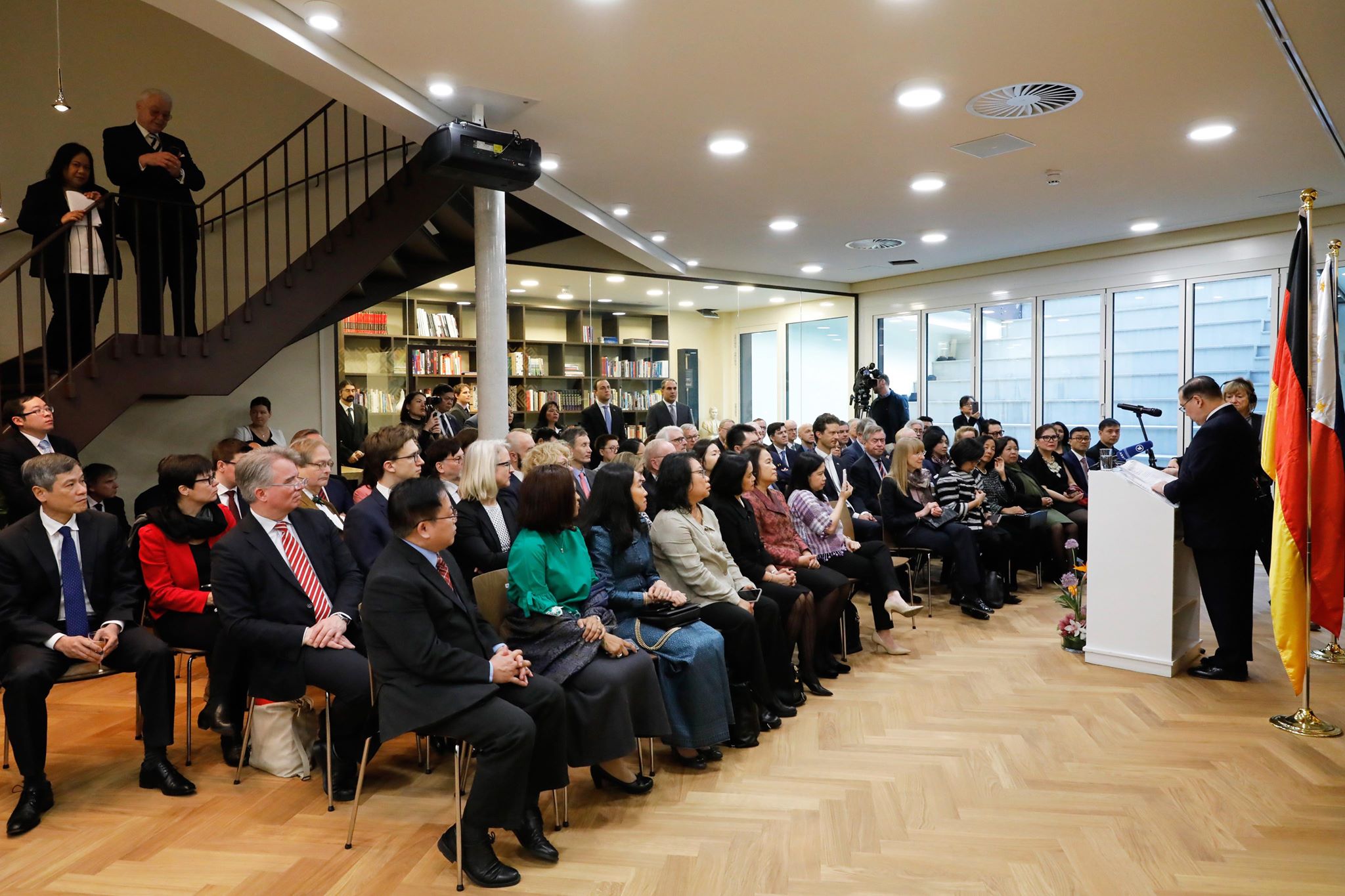
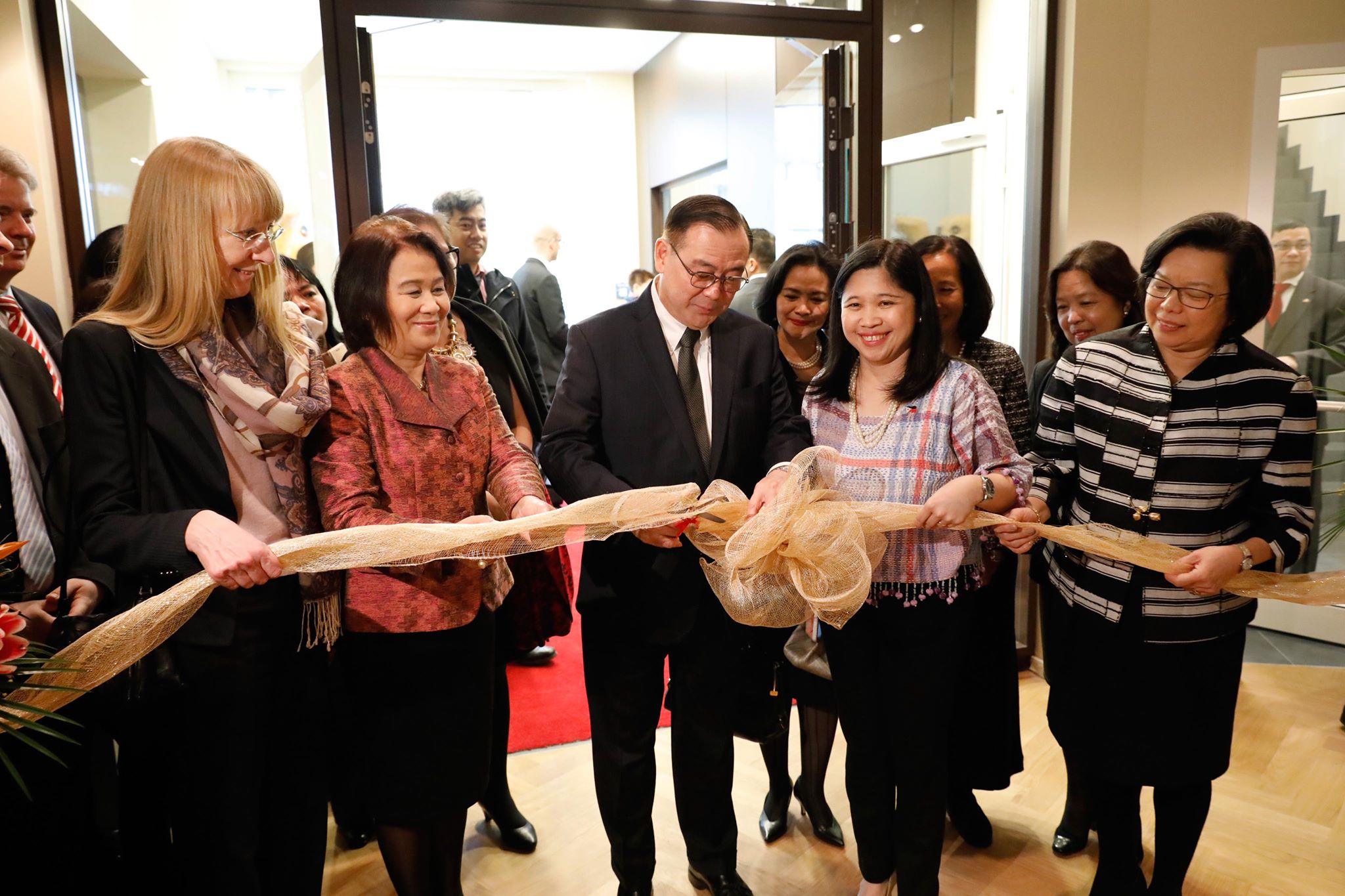
BERLIN, Germany (18 February) – Secretary Teodoro L. Locsin, Jr. today inaugurated the new chancery of the Philippine Embassy in Berlin located at Luisenstrasse 16, 10117 Berlin-Mitte, near the German capital’s iconic Brandenburg Tor.


Secretary Locsin cuts the ribbon, assisted by, from left, Ambassador Lepel, CDA Pono, Undersecretary De Vega, and former Ambassador Thomeczek


Joining him in the ribbon-cutting were DFA Undersecretary for Administration and Ambassador-designate to Germany Ma. Theresa Dizon-De Vega, Chargé d’affaires Lillibeth V. Pono, and former and incumbent DFA officials who played a role in the completion of the building project. Among them were former ambassadors to Germany Melita Sta. Maria-Thomeczek and Ma. Cleofe Natividad, who now helms the Philippine Embassy in Vienna, and former Undersecretary for Administration Linglingay Lacanlale, who is now ambassador to Argentina. Also present were DFA Assistant Secretary for European Affairs Ma. Amelita Aquino, and Consul General Evelyn Austria-Garcia of the newly reopened Philippine Consulate General in Frankfurt.

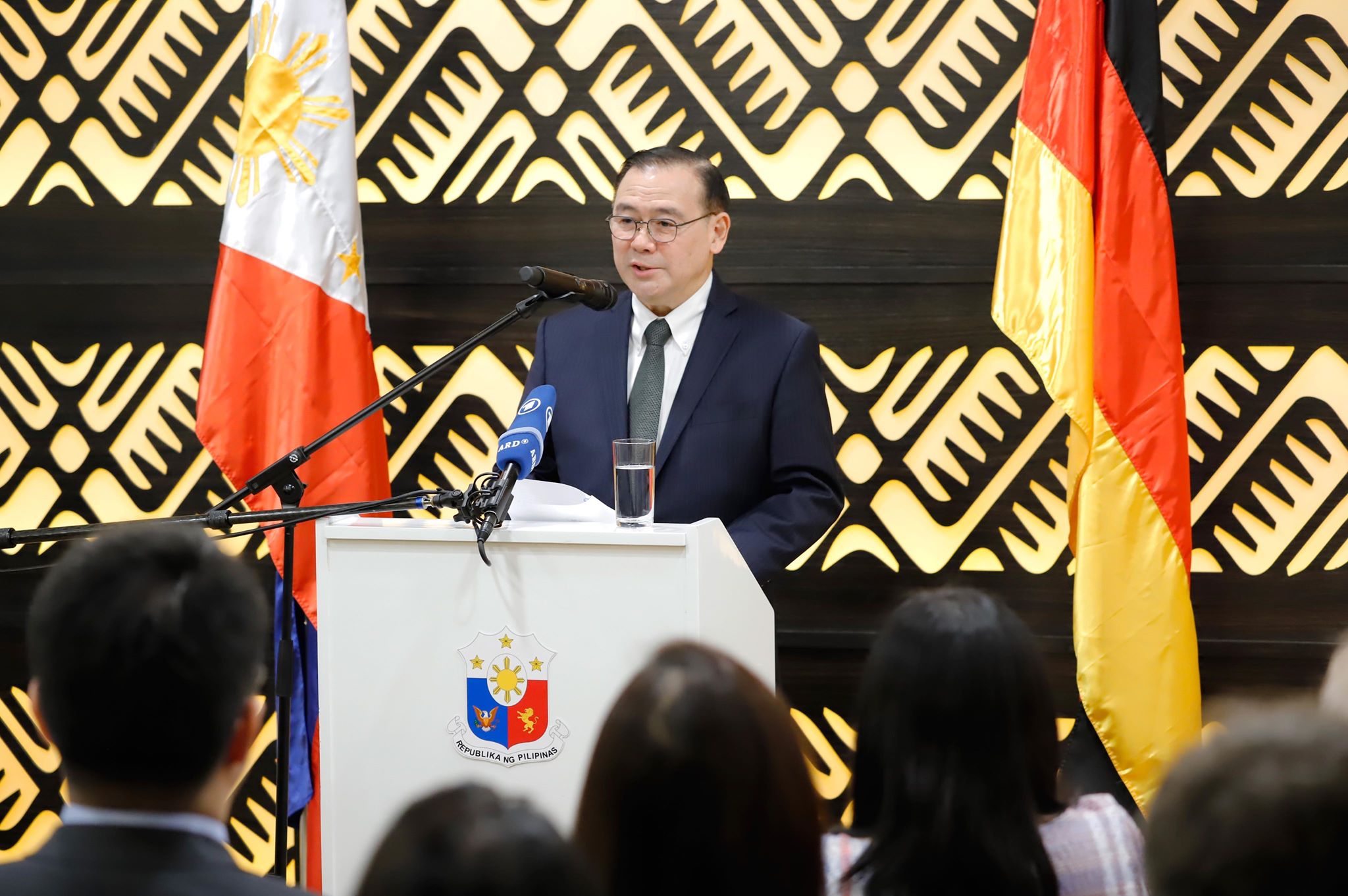
The highlight of the inauguration was the Secretary’s address entitled “Independent and Sovereign: The Foreign Policy of the Philippines in a Changing Global Order” before a distinguished gathering of more than 60 guests invited by the embassy. Present were ambassadors and other diplomats from other ASEAN and key Asia Pacific countries, and representatives of the host government, business and civil society. Filipino Community representatives were likewise present.

Before the ceremony, the Secretary had a brief exchange with Ambassador Ina Lepel, head of the Asia-Pacific Directorate of the Federal Foreign Office, who offered her congratulations on the new chancery.

Secretary Locsin presents his views on an independent and sovereign foreign policy.


After the ceremony, the audience was treated to musical performances by Filipino classical singer Jose Mari Rubio and pianist Abellardo Galang II serenaded the audience, and to contemporary Filipino food by Ayan restaurant.

The new chancery is an eight-story property developed on a turnkey basis by Zielconcept GmbH and includes a large cultural space and library to serve as a hub for the embassy’s public and cultural diplomacy programs. (END)

« Previous Page
Next Page »

CONNECT WITH US

  • 
  • 
  • 
  • 

CONTACT US

Luisenstrasse 16, 10117 Berlin
Phone: +49 (0) 30 864 95 00
info@philippine-embassy.de
(General Inquiries only)
For Consular-related Queries please send directly to the respective email addresses below
)

Assistance to Nationals (ATN) / Emergency Hotline: +49 (0) 173 421 7750
(Please help us keep the line free for those with real emergencies. Do not call this number for regular inquiries.)

Consular Hotline: +49 (0) 173 521 5703 (For queries on Consular Services)

Email Addresses:

Passport
(passport@philippine-embassy.de);

Authentication, Notarial, and Legalization
(authentication@philippine-embassy.de);

Visa
(visa@philippine-embassy.de);

Civil Registry
(civilregistry@philippine-embassy.de);

Citizenship
(Renunciation; Re-acquisition/Retention) (citizenship@philippine-embassy.de);

Other Consular queries
(consular@philippine-embassy.de)

Opening Hours
Consular Section
Mon – Fri – Fri 09:00H – 16:00H
(Except on Philippine and German holidays)


Philippine Migrant Workers Office (MWO)

For OEC and Verification of Employment Contracts of Balik-Manggagawa in Germany, Belgium, Luxembourg, The Netherlands, and Russia:

Mobile: +49 17681317465 (WhatsApp);
email: mwo.germanyoec@gmail.com

For accreditation of Agency and Direct Hires in Germany, Belgium, Luxembourg, The Netherlands, and Russia:

Mobile: +49 15229021623 (WhatsApp/Viber)
email: germany@mwoberlin.com

For OWWA membership, welfare, and labor case assistance:

Mobile: +49 152 2823 8085 (WhatsApp)
email: owwamemb@gmail.com; mwo_berlin@dmw.gov.ph

Recent Stories

  • Philippine United Nations Security Council (UNSC) Bid for 2027-2028
  • Philippine Embassy Consular Outreach Mission in Hamburg, 25-26 April 2026
  • UPLIFT Series: Babaylan Unfiltered – Celebrating Filipina Leadership in Berlin
  • Ambassador Maria Teresa T. Almojuela Presents Credentials to President Steinmeier
  • PHILIPPINE CUISINE TAKES SPOTLIGHT IN WORLD’S TOP TOURISM FAIR
Copyright © 2026